Flashings from A to Z: eaves, verge, valley and ridge
The flashing is the cheapest part of the roof and the most common cause of its problems. When water gets into the eaves, when the wind lifts the edge at the gable or when the valley overflows in a heavy downpour, it is almost never the covering that is at fault — the fault lies with the sheet-metal detail that is wrongly sized, too short, or screwed down so that it cannot expand. This is a guide through the names, the dimensions and the rules by which flashings are made — and through the mistakes you pay for over years.
Who is who on the roof
Sheet-metal jargon is full of Germanisms and regional names, so the same piece of sheet has three names with three tradesmen. Here is the translation:
- Eaves flashing (eaves apron, gutter inlet flashing) — at the eaves; it carries water from the covering into the gutter and stops water from working its way under the covering or running down the facade.
- Verge flashing (wind guard, gable or end flashing, barge trim) — at the gable; it stops the wind from driving rain under the covering and stops suction from lifting the edge of the roof.
- Valley flashing (valley, valley gutter) — in the concave junction of two planes; it takes water from both sides and is therefore the most heavily loaded sheet on the roof.
- Ridge flashing (ridge piece, ridge cap) — at the ridge; it closes the junction of the planes, but must let air through.
- Wall abutment flashing (wall flashing, abutment sheet metal) — where the roof meets an upright wall, a parapet or a chimney.
- “Drip edge” — not an element but an additional fold at the edge that stops water from escaping over the edge by capillary action. That is why a “valley flashing with a drip edge” is not decoration but function.
Developed width: the only dimension that determines the price
The developed width is the length of the flat strip before it goes into the press brake — that is, the sum of all the legs of the cross-section. The flashing is charged by it, in classes. And the classes are not entirely arbitrary: part of the boundaries falls exactly on the division of the 1250 mm sheet — 1250 by two is 625, by three 416.7, by four 312.5, by five 250 mm. The remaining boundaries follow round centimetre steps from the price list. The practical consequence is the same: a flashing of 313 mm and one of 318 mm are not the same money, although the difference is half a centimetre. Drag the slider:
Developed width, price and sheet yield
Price per linear metre
4.91 €
incl. 25 % Croatian VAT · 3.93 € net · class 31.3–37.5 cm
Strips from a 1250 mm sheet
3
Sheet waste
20.8 %
* The prices come from our price list for flashings by classes of developed width. The linear metre is charged by class, not the square metre of the sheet. The yield is calculated from a flat sheet of developed width 1250 mm (the price list item “Flat Sheet Developed Width 1250 mm”) — galvanised sheets in the 1×2 m format divide differently. The developed width is the length of the strip before bending: if you measure from the finished cross-section by the external dimensions, subtract about 1 mm per 90° bend.
The price calculation of flashings by developed width is indicative and not a binding offer. The final price is confirmed by a written quote after checking measurements, quantities, material availability and the cost of delivery and installation. Terms of purchase: terms and conditions.
One trap when measuring: if you work out the developed width by adding up the external dimensionsof the finished cross-section, you will get about a millimetre too much for every 90° bend (the sheet “shortens” when bent, because the material travels around the radius). With six bends that is six millimetres — immaterial, unless you are right on the boundary of a price class. Our Flashing Designer works out the developed width from the legs you draw, so that problem falls away.
Bending radius: the coating decides, not the sheet
This is the detail that separates a good flashing from one that rusts at the bend within five years. The minimum bending radius is determined not by the steel but by the coating, and it is measured by the T-bend test to EN 13523-7: the marking nT means that the coating stays free of cracks when the sheet is bent around n of its own thicknesses. A standard polyester system typically holds ≈3T, matt systems ≈2T— so matt takes the sharper bend. The conversion into millimetres is better left to the data sheet of the specific system than to a formula. A sheet-metal worker’s “sharp” bend below that marking is below the specification of the coating — cracks in the paint on the outside of the bend are then not seen straight away, but when they start to rust. How the coatings differ we wrote about in the article on top coats.
In addition, two things you should know about tolerance and temperature. The angle cannot be bent perfectly precisely: the general tolerances for bent sheet (ISO 2768-1, medium class) allow an angular deviation that grows as the leg gets shorter — anyone who draws an eaves flashing with a 15 mm leg will get a larger deviation, and that is not a manufacturing fault. A note because of a frequent misunderstanding: our declared CNC tolerance of ±0.2 mm is dimensional — it applies to the lengths of the legs, not to the angle of the bend. And: colour-coated sheet is not bent in the cold. In practice it is worked at a temperature above about +10 °C (ideally in a heated space); sheet brought in from a freezing lorry has to stand before bending, because the coating is brittle at a low temperature.
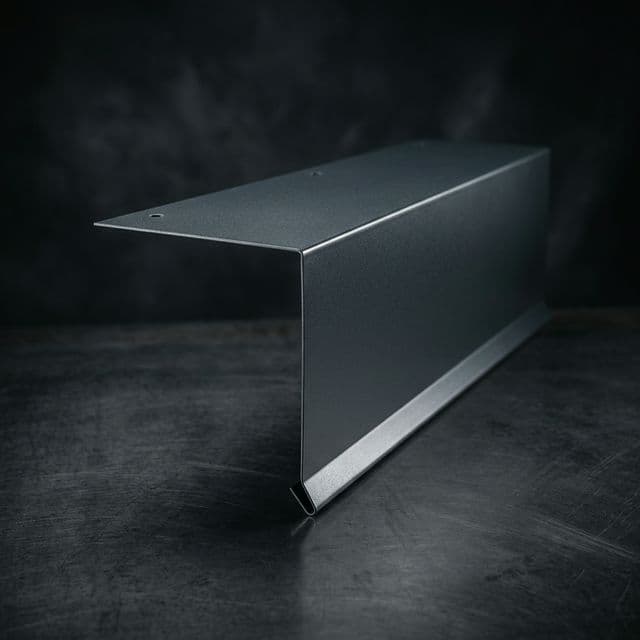
Flashing Designer — draw it and order it
Draw the cross-section of the flashing leg by leg, and the tool works out the developed width and the price by class. Eight ready presets: eaves flashing, verge flashing, ridge cap, valley flashing, wall abutment flashing, window sill, angle and Z profile.
Overlaps, expansion and pitch
Flashings are continued with an overlap of at least 10 cm (this concerns the flashing; the transverse overlap of the covering itself requires more — see the guide to the trapezoidal profiles), always in the direction of water flow — the upper piece over the lower one. At smaller pitches the rules get stricter: the flatter the roof, the more slowly the water runs off and the more easily it works its way underneath, so a larger overlap is required, and below about 15° the simple overlap gives way to a watertight joint (soldered, riveted with a seal). That matters with valley flashings, where the pitch is always smaller than the pitch of the roof planes themselves.
And expansion. Steel expands by about 0.012 mm per metre and degree, so a 3-metre piece moves more than 3.5 mm over a summer-to-winter difference of a hundred degrees or so — on a six-metre piece, twice that. That is why long flashings are not fixed rigidly along their whole length but with sliding clips, individual pieces are kept within about 3 metres for direct fixing, and an expansion element goes in roughly every 15 metres — at half that spacing from a corner or an end, and at a quarter from an internal corner, because that is where the damage most often appears. The same rule applies to long gutters; we set it out in the article on drainage. A wavy flashing and screws torn out are not bad sheet but forgotten expansion.
Six mistakes we see most often
- An eaves flashing that is too short, or a membrane that ends behind it — the water goes behind the gutter, into the eaves.
- A verge flashing without an overlap, or with the overlap against the wind direction — the edge lifts on the first stormy night.
- A valley flashing sized “by eye”. The valley flashing takes water from two planes and its developed width depends on the catchment area and the pitch — on large or shallow roofs 450–500 mm is not unusual. If in doubt, take the wider version or send us the plan.
- A nail or a screw through the valley flashing. The valley flashing is held by clips; every penetration in it is a future leak.
- A ridge flashing without ventilation — without spacers and a mesh the roof stops breathing, and you pay for that in condensation (more about that here).
- Mixed metals. A copper pipe or flashing above galvanised sheet destroys the zinc — the rule and examples in the article on drainage.
Flashings are the place where the most is saved and the most is lost. A few centimetres of developed width, one overlap more and a correct bending radius cost next to nothing in the quotation — and it is precisely on them that it depends whether the roof will be dry for ten winters.
We keep the prices of flashings by classes of developed width public, which is not usual in this trade — how and why is in the story about Modeco and the public price list.
Flat Sheet Colour-Coated RAL 7016/9005
The raw material from which we cut and bend flashings — galvanised sheet with a polyester coating in RAL 7016 or 9005. We confirm the width of the sheet when the order is placed.
Frequently asked questions
The developed width is the length of the flat strip of sheet before bending, that is the sum of all the legs of the cross-section. The flashing is charged by it, in price classes.
English version of the Croatian original: Opšivke od A do Ž: okapnica, vjeterlajsna, uvala, sljemenjak.