Polyester 25 µm or matt 30–35 µm: which top coat really lasts?
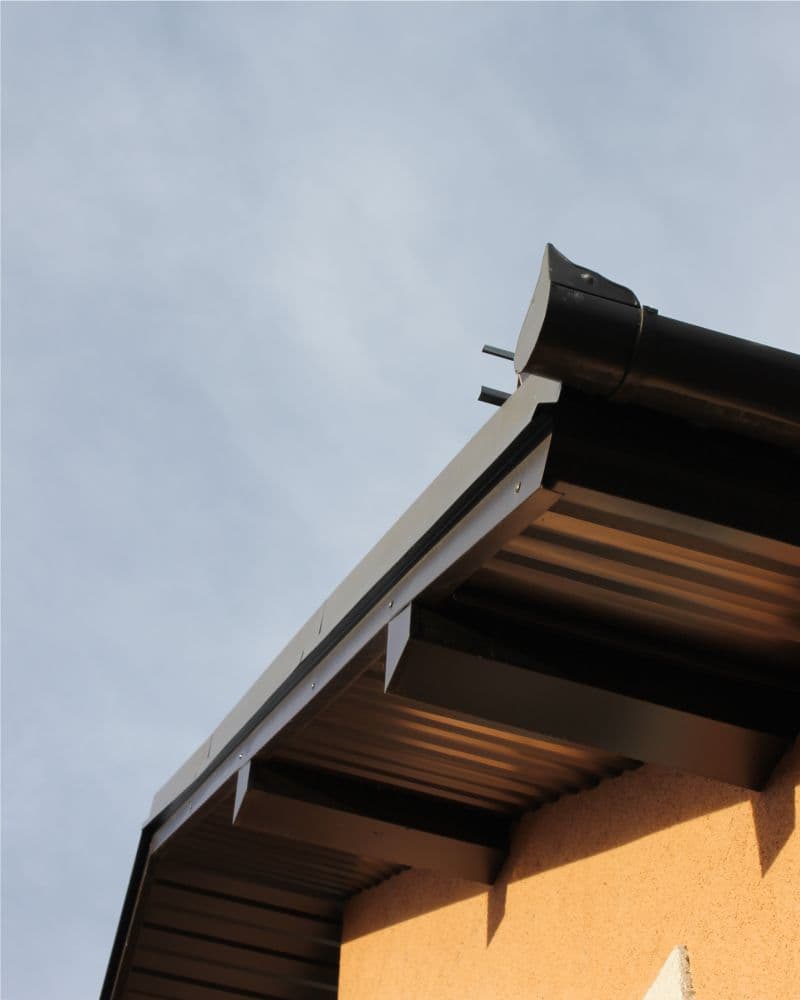
Two sheets, both in anthracite RAL 7016, look identical on the day of installation — and the difference in the quotation is a few tens of cents per square metre. Ten years later one roof is still deep grey, while the other has faded into an uneven, chalky shade that no washing brings back. The difference was not in the colour but in the coating system underneath it: a nominal 25 micrometres of polyester against 30–35 micrometres of a matt system. In this guide we break down what that difference means physically and when each system pays off in engineering terms.
Let us clear one thing up straight away: the “colour” on galvanised sheet is not one layer but a system— an epoxy primer for adhesion and a corrosion barrier, and a polyester top coat that carries the shade and the UV protection. When a data sheet says “25 µm”, that is the primer and the top coat together (typically 5 + 20 µm) — in the article on Z275 we drew those layers separately for the sake of clarity; it is the same system, only broken down. Matt systems carry a thicker primer and a thicker top coat (for example Granite Deep Mat: 10 + 25 µm; the matt variant from SSAB 30 µm in total). All of that sits on the zinc barrier — we wrote about it in detail in the article on the Z275 standard — the paint protects the zinc, the zinc protects the steel, and factory guarantees on the coating apply only on a suitable zinc base.
Anatomy of the coating system — choose a system
Paint thicknesses to scale · zinc and steel schematic
UV class (EN 10169)
Ruv3
Corrosion class
RC3–RC4
Typical factory guarantee
15 (up to 20) years
Flexibility (T-bend)
≈2T
Developed for roof profiles and tile-profile sheet; dark RAL shades, facades without reflection.
* The values are typical ones from factory data sheets (ArcelorMittal Granite®, SSAB GreenCoat®, USS Kosice) and they vary by manufacturer and by version of the system; guarantees depend on the environment, the roof pitch and the colour category. This is an orientation for the conversation with the supplier, not the specification of a specific delivery.
Classes are read off the data sheet, not off the brochure
The European standard EN 10169 assigns coatings measurable classes: Ruv for UV durability (Ruv2 → Ruv4; higher is better — gloss retention and the change of shade ΔE after ageing are measured) and RC for corrosion resistance, aligned with the environmental categories C1–C5 from EN ISO 12944-2. Standard polyester of 25 µm typically carries Ruv2(–3) / RC3 — it is designed for moderate UV exposure. The matt system of 30–35 µm lifts the UV resistance to Ruv3 (with some manufacturers the corrosion class to RC4 as well), while PVDF and thick-film HDX systems play in the league of Ruv4 / RC4–RC5+.
For context: Đakovo and the greater part of Slavonia fall into the corrosivity category C2–C3 (rural to urban-industrial). That means that for farm buildings standard polyester with RC3 is a perfectly legitimate choice — and that is why it is the industry standard. The UV side of the story is the one where the matt system begins to pay off, especially on dark shades.
Matt is not (only) aesthetics — it is harder and more flexible
The textured “wrinkle” surface of the matt system is mechanically harder: according to the measurements by SSAB the scratch resistance rises from 20 N (standard) to 25 N. More important still for profiled sheets — matt systems have better flexibility: the minimum bending radius without the coating cracking falls from ~3T to ~2T (T = the thickness of the sheet), with adhesion preserved from 1T. On tile-profile sheet, where the machine presses the transverse steps deep, it is precisely the T-bend that decides whether the coating on the fold will still be whole in ten years. On top of that, on a surface with a gloss of ≤5 GU the micro-scratches from installation and from branches are optically almost invisible — on a glossy surface every one of them breaks the reflection.
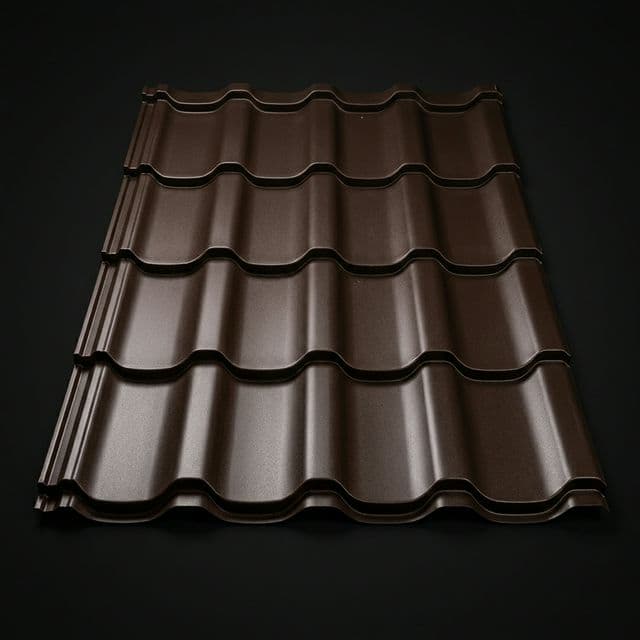
Tile-Profile Sheet RAL 7016/9005
The deeply pressed profile on which the flexibility of the coating (T-bend) shows the most. Standard polyester system, cover width 1100 mm, six RAL shades of the second group; matt version on request.
Dark RAL shades work against the coating
Anthracite 7016 and black 9005 — the most sought-after shades — are at the same time the heaviest load on the coating. In summer a dark surface heats up to the order of 80 °C, close to the upper working limit of polyester (~90–100 °C), and the higher temperature accelerates the ageing of the binder and chalking: UV radiation breaks the resin down and the pigments come out on the surface as a white powder. That is why the factory guarantees on appearance depend explicitly on the “colour category” — dark shades are the less favourable category. The engineering conclusion is simple: the darker the roof and the stronger the exposure to the sun, the stronger the argument for matt 30–35 µm (or PVDF for facades that have to keep their shade).
The engineering prescription
- Warehouse, canopy, agricultural building (C2): standard polyester 25 µm — RC3/Ruv2 covers the use, the budget stays in your pocket.
- Family-house roof in a dark RAL, tile-profile sheet: matt 30–35 µm — Ruv3, a harder surface, T-bend 1–2T on the pressed folds, no reflection.
- An architectural facade that has to hold its shade: PVDF 35 µm (Ruv4).
- The coast, a swimming pool, heavy industry (C4–C5): thick-film systems of the HDX class — for Slavonia most often more than needed, for the Adriatic a subject that is discussed before ordering.
The standard Modeco range holds a quality polyester system in two RAL groups; for matt and PVDF systems get in touch with an enquiry — tell us the use of the building and the environment, and we will come back with the coating class that makes sense.
And finally — when you compare two quotations for the “same” sheet, do not ask only about the RAL and the price. Ask: which coating system is it, which Ruv and RC classes does it have to EN 10169, how long is the factory guarantee, and on which zinc base does it sit? Four questions that separate a roof from a facade film.
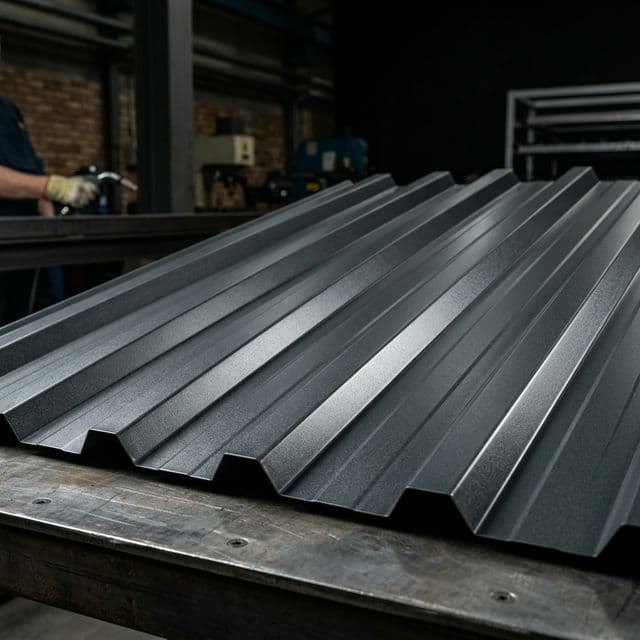
Trapezoidal Sheet T-18 RAL 7016/9005
A polyester coating system on a Z275 galvanised core, cover width 1100 mm. For spans and structural behaviour see our guide T-18 vs T-35 vs T-45.
Frequently asked questions
The thicker matt system has greater resistance to UV radiation and better flexibility at a bend. Standard polyester typically holds a T-bend rating of about 3T, and matt systems about 2T, which means that matt takes a sharper bend without the coating cracking.
English version of the Croatian original: Poliester 25 µm ili mat 30–35 µm: koji završni premaz stvarno traje?.