T-18 vs T-35 vs T-45: how to choose the trapezoidal profile by purlin spacing
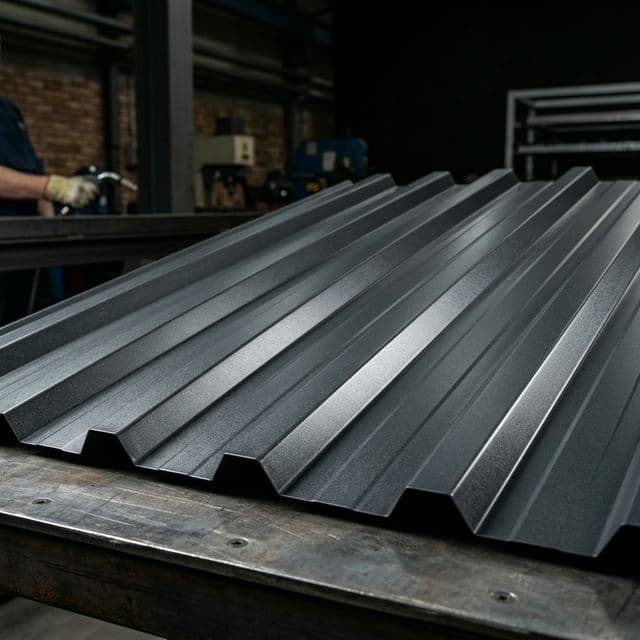
Purlin spacing — that one figure in millimetres decides whether your roof will sleep soundly under February snow or whether in spring you will be calling the sheet-metal worker about permanently crushed ribs. When customers ring and ask “which trapezoidal sheet is the best”, the answer of the Sheet Metal Doctor always begins with a counter-question: how far apart are your supports? Because T-18, T-35 and T-45 are not three “designs” of the same product — structurally they are three completely different beams.
All three profiles come out of the same galvanised steel (typically S250GD with a Z275 zinc coating to EN 10346, declared to the standard HRN EN 14782 for self-supporting metal roof coverings). The difference arises in the rolls: the higher the rib, the greater the moment of inertia the sheet gains — and with it the right to bridge a larger span without deflection.
Three profiles, three rib heights
Rib heights at the same scale (schematic)
Cover widths: Modeco range · masses: typical values for 0.50 mm steel
The cover width falls as the profile gets higher (T-18 covers 1100 mm, T-45 “only” 1000 mm) because more steel goes into the depth of the rib. Between T-18 and T-35 there is also the intermediate step T-22 (cover width 1070 mm) — structurally close to T-18 with a touch more reserve, so the same battening rules apply to it as to its lower brother. That is the price of the moment of inertia — and the reason why the higher profile costs only a few tens of cents more per m², yet carries almost twice the span.
What purlin spacing can the profile take?
Drag the slider and see who stays in the green. The criterion: a continuous load of ≈ 1.25 kN/m² (the characteristic snow load of continental Croatia — Region 1, sk ≈ 1.1 kN/m² up to 100 m above sea level to HRN EN 1991-1-3 with the national annex — plus an engineering reserve), with a deflection limit of L/200 which, on thin-walled sheets, is almost always governing before failure. By load we mean a uniformly distributed load over the roof plane.
Purlin spacing (single span)
1.50 mTypical load tables of the strip manufacturers (EN 1993-1-3, S250GD, single-span beam). The profile geometry varies from one manufacturer to another — this is an orientation, not the structural calculation of your building. For T-45 and larger spans ask for the load table that goes with the specific delivery.
Translated into practice, the way we batten on site: keep T-18 on battens spaced 50–80 cm apart — that is what Croatian manufacturers recommend as well, and the tables show why: already at 1.25 m the single-span deflection eats up the reserve. T-35 is therefore the king of value for money — with a 0.50 mm core it comfortably bridges up to ~1.5 m, and with a reinforced core of 0.63 mm up to 2 m, which on a hall roof means half as much timber or steel under the sheet. (In an earlier analysis we quoted a conservative 120 cm — that is the recommendation for battening with no reserve at all in the tables; single-span tables allow more.) T-45 is the load-bearing profile for industrial spans and low-pitch roofs — its tables go further still, but those we always read from the specific technical data sheet.
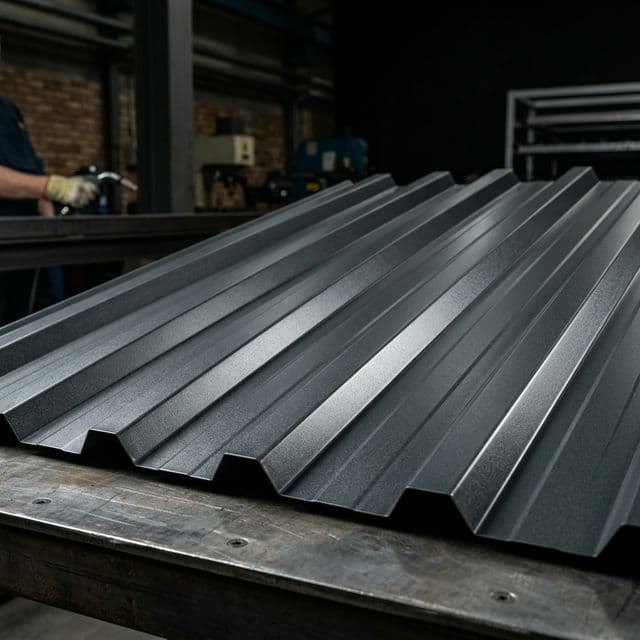
Trapezoidal Profile T-35 · RAL 7016
The universal roof profile with the best ratio of load capacity to price: cover width 1035 mm, Z275 galvanised core with a polyester coating. Anthracite and 5 more RAL colours from the premium group.
Roof pitch: where T-18 loses its vote
The purlin spacing is half the story — the other half is the pitch. A trapezoidal covering generally requires a minimum pitch of 5–6°, and that with compulsory sealing of every transverse overlap (a minimum 20 cm overlap with sealing tape). Below ~8° you enter the regime of special rules for fastening and drainage. Low profiles such as T-18 in practice live best on roofs from ~15° upwards: a shallow rib simply does not have the drainage capacity to swallow a heavy downpour or the melting of a packed layer of snow at a small pitch. Exactly the opposite holds for T-45 — a deep rib of 45 mm is a water motorway, which makes it the profile of choice for low-pitch industrial roofs.
Core thickness and coating: small numbers, big consequences
Every table in this guide applies to a core of 0.50 mmand above — so always check the core thickness in the quotation and in the mill certificate before ordering. “Bargain” sheets with a core of 0.45 mm or thinner drop out of every spacing listed here — we wrote about that in detail in the analysis of the structural behaviour of trapezoidal and tile-profile sheet. For the coating a simple rule applies: standard gloss polyester of 25 µm is a solid workhorse, while matt polyester of 35 µm carries a thicker protective layer and better resistance to UV and micro-scratches — on south-facing roofs and at higher altitudes that difference shows after the first decade. And finally: under cold sheet always think about anti-condensation fleece — the physics of the dew point does not negotiate.
The Doctor’s prescription
Trapezoidal Profile T-18 · RAL 7016
The classic of family-house roofs: cover width 1100 mm, Z275 core, premium RAL group. With the fleece surcharge it also solves condensation in cold roof spaces.
Frequently asked questions
The number in the designation is the rib height in millimetres. A higher profile takes a larger purlin spacing: T-18 is used on family-house roofs with dense battening, and T-35 and T-45 on halls where the purlins are further apart. The cover widths are T-18 = 1100 mm, T-22 = 1070 mm, T-35 = 1035 mm and T-45 = 1000 mm.
English version of the Croatian original: T-18 vs T-35 vs T-45: Kako odabrati trapezni profil prema rasponu podrožnica.