Tile-profile sheet: 5 kg/m² instead of 45 — what a lighter roof means for the roof structure and the price
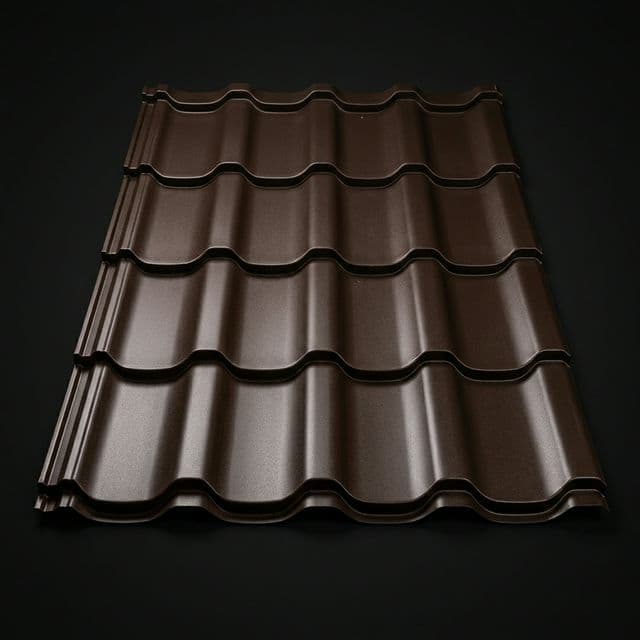
On a roof of a hundred square metres a concrete tile parks more than four tonnes — the mass of almost three cars — at the highest point of your house. Tile-profile sheet covers the same plane with half a tonne. That ratio of roughly eight to ten times is not a marketing quip but a permanent load that your roof structure, your walls and your foundations carry every day for the next fifty years. In this guide we set out what that difference really means for the structure, for renovations, for wind, for snow and for the final price — honestly, including the things that are NOT saved on.
How many tonnes does your roof structure carry?
* Masses of the coverings from the catalogue data of the manufacturers (clay: Nexe Glinex Kontinental; concrete: BMI/Bramac Klasik); according to EU sources clay runs 40–55 and concrete 35–50 kg/m² depending on the model. This is an illustration of the permanent load of the covering — snow, wind and the self-weight of the timber are calculated on top of it.
What the mass means for the roof structure — without exaggeration
In the structural calculation the covering enters the permanent load G (EN 1990): tiles bring ~0.40–0.45 kN/m², sheet ~0.05 kN/m². Let us be honest as engineers: the saving on the rafters is not proportional to the mass of the covering, because the snow (for continental Croatia sk ≈ 1.1 kN/m², as we calculated in the guide to trapezoidal profiles) and the weight of the timber itself stay the same. A lighter covering typically means a rafter section one or two grades smaller, or a larger spacing of the rafters — the actual dimensions are always determined by the structural engineer for your span and pitch.
Where the difference becomes dramatic: the earthquake. The seismic force grows with the mass, and the mass of the roof sits in the least favourable place — at the top of the building. Replacing a covering of ~45 kg/m² with a covering of 5 kg/m² on 100 m² of roof takes ~4 tonnes off the top of the structure (qualitatively, following the logic of EN 1998 — the seismic calculation is the designer’s job). And renovations: an old roof structure designed for asbestos cement (~15 kg/m²) accepts tile-profile sheet without strengthening (with a mandatory inspection of the health of the rafters and the battens), while a concrete tile means a ~3× greater load and a mandatory structural check. When replacing asbestos cement do not forget: asbestos is disposed of under special rules, through authorised contractors.
A light roof does not hold the wind with weight — but with screws
The flip side of lightness: a covering of 5 kg/m² contributes practically nothing to the resistance to wind uplift — the fixing takes it all. Under EN 1991-1-4 the greatest uplift arises in the edge and corner zones of the roof, so the screwing is denser along the eaves, the ridge and the gables. The practice of the manufacturers of tile-profile sheet: 6–9 screws/m² with an EPDM washer, in the trough of the wave, never overtightened. In money: 6–9 screws × 0.11–0.16 € ≈ 0.8–1.4 €/m² — negligible within the system, decisive in a storm.
Snow slides on smooth sheet — and that is your problem
A rough, heavy tile holds the snow; smooth sheet releases it in slabs. That is why above entrances, paths, parking spaces and gutters snow guards are not an option but an obligation — on steeper and longer roofs in several rows. With them goes the old truth about light sheets: a small thermal mass means faster cooling below the dew point and condensate — the solution is anti-condensation fleece, whose physics we set out in the article on condensation.
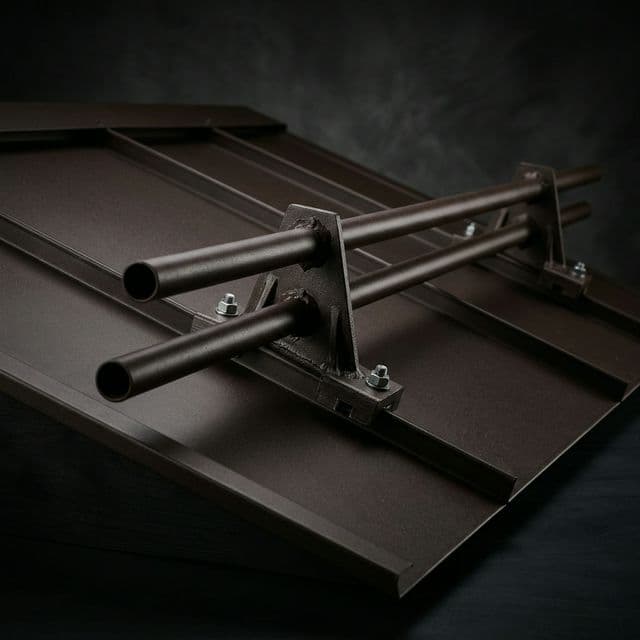
Snow Guard Continuous Developed Width 25
Continuous linear protection against sliding snow for metal roof coverings. Price by developed width class (price list: 3.61 €/m for a developed width of 25–31.3 cm) — confirm the exact model and class with your order.
Logistics: half a tonne instead of four pallets
For a roof of 100 m² a clay tile means ~4 pallets and over 4 tonnes of goods that have to be delivered, lifted with a crane and laid piece by piece (with the usual allowance for breakage in transport and cutting). Tile-profile sheet for the same plane weighs ~0.5 tonnes: the sheets are cut to measure up to the length of the rafter, a cover width of 1100 mm covers row by row, and one man lifts the modular panels. Less mass = cheaper transport, faster installation, fewer working hours on the roof.
The engineer’s recipe
- New build: a lighter covering = slimmer timber and calmer seismics, but the snow and the batten every ~35 cm remain — with tile-profile sheet the battening is not where you save (why — we have written about it already).
- Renovation of asbestos cement or shingles: tile-profile sheet is typically the only covering that an old roof structure takes without strengthening — with an inspection of the rafters and new fleece.
- Switching to tiles on an old roof structure: exclusively with a structural check — a 3–8× greater permanent load is not a detail.
- Always with sheet: snow guards over passageways, denser screwing of the edge zones, anti-condensation fleece.
On price, the covering itself speaks in favour of sheet: our tile-profile sheet costs 7.92–9.44 €/m² (prices from the shop, depending on the RAL group), while clay tiles on the market run roughly 24–42 €/m² and concrete tiles 12–20 €/m² — and with heavy coverings stronger timber, a crane and slower installation come on top of that. We always do the final calculation for the system, not per square metre of covering.
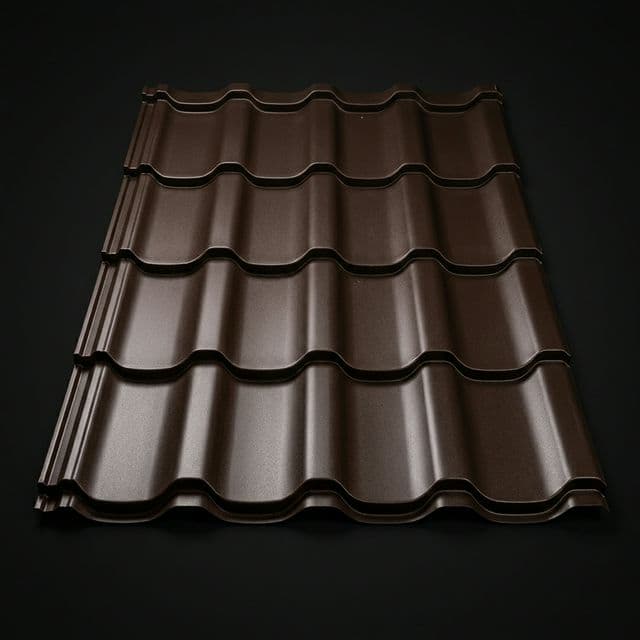
Tile-Effect Roof Sheet RAL 7016/9005
~5 kg/m² on a Z275 galvanised core, cover width 1100 mm, cut to the measure of your rafter. Standard polyester system; matt version on request.
Frequently asked questions
Tile-profile sheet weighs about 5 kg/m², and a concrete tile about 45 kg/m². On a roof of 100 m² that is the difference between roughly half a tonne and four tonnes.
English version of the Croatian original: Lim u obliku crijepa: 5 kg/m² umjesto 45 — što lakši krov znači za krovište i cijenu.