Roof sweat: the physics of condensation and why fleece is not a luxury but a standard
Condensation is the invisible but merciless enemy of every uninsulated roof. Watching a metal roof apparently ‘leak’ on cold mornings is a common reason for panic among investors. Many immediately suspect poor installation, a sheet drilled through or overtightened screws. But the water that drips is not the result of mechanical damage — it is the inexorable law of physics. The dew point turns the invisible moisture in the air into liquid water the moment warm air from inside your building touches the cold underside of the sheet, the so-called ‘dead’ surface.
In industrial and especially in agricultural halls, where an enormous amount of moisture comes from living creatures, machines or stored organic material, this problem moves from the aesthetic to the catastrophic. Dripping acidic condensate can permanently damage and corrode machinery worth millions, contaminate silage feed for animals or — in the worst case — cause sparking and short circuits on the exposed electrical installations of the building.
Physics 101: where does the moisture come from?
To solve the problem, we have to take it apart. Depending on its temperature, air can hold a certain amount of water vapour. Warmer air behaves like a bigger sponge and holds considerably more moisture. The problem arises at night, when the outside temperature falls sharply, say to -2°C, cooling the steel covering. Warm air from inside the hall (for example +15°C at 80% relative humidity) rises under the roof and, on meeting the cold sheet, abruptly loses the ability to hold the vapour. The excess condenses as fine droplets.
Agriculture & livestock
Just a few dozen head of livestock produce tens of litres of water vapour a day, through breathing and the evaporation of the manure. Because of the ammonia, this condensate is highly corrosive.
Industry and warehouses
Internal-combustion forklifts, process heating of halls, uninsulated floors from which ground moisture evaporates during the drying phases of the concrete.
The solution: the anatomy of anti-condensation fleece
In engineering and financial terms, for halls that are not heated, installing thick insulating thermal panels (sandwich panels from 50mm upwards) often amounts to throwing money to the wind. The most elegant, the cheapest and the safest solution on the market is anti-condensation fleece on the underside of the profile (most often a trapezoidal one).
Applied at the factory during production, while the sheet is being rolled into the desired profile, this synthetic non-woven material (often of PES fibres) works on the principle of capillary absorption, just like a microscopic sponge.
Capacity up to 1,000g / m²
Technical limit values
An interesting engineering fact that many people do not grasp is the influence of the pitch of the roof. Because of the law of gravity, the steeper the roof, the less moisture per square metre the fleece will be able to hold within itself, because part of the excess water slowly runs off with gravity down the texture and into the gutter before the fleece reaches its saturation maximum of a kilo of water (1 litre) per square metre.
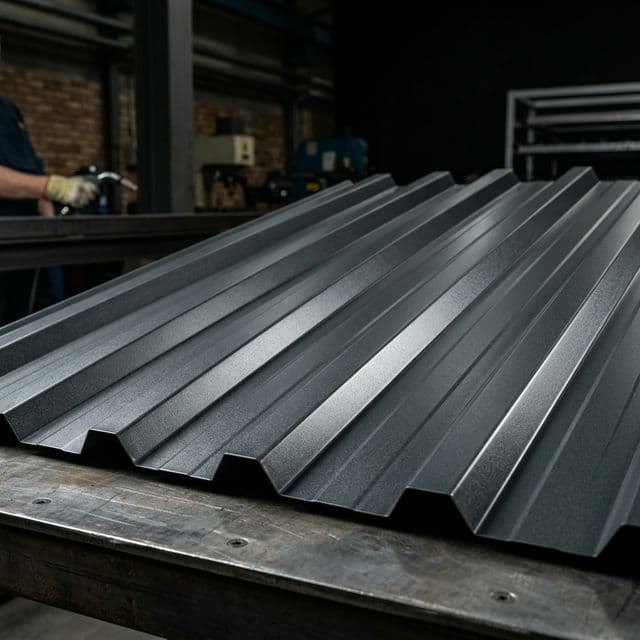
T-35 Cover Width 1035mm RAL 7016/9005
Thanks to a wave height of 35mm its load-bearing capacity is unreal. It comes with the option of factory-bonded fleece, which is ideal for uninsulated agricultural sheds.
Why fleece is NOT magic (a critique of ventilation)
The greatest misconception in circulation is the idea that the fleece makes the moisture disappear. The fleece only stores the moisture temporarily. Its primary power and purpose is to keep frozen droplets from falling down your neck overnight and on a cold morning.
During the warmer part of the day, or as soon as the outside conditions arise (wind blowing), the fleece has to evaporate the moisture back into the atmosphere. If you build a hall with fleece and seal it up (close every vent on every side), you do not have a functioning solution – you have a pool of water frozen under the sheet that solves nothing, because it has no way to dry out and reset its capacity to zero. Correct installation of a roof means leaving at least 2% of the roof area for air, in the form of side grilles or an open ridge.
Zdenko’s engineering checklist
Planning an uninsulated barn? Do not ask about the price. Ask for trapezoidal sheet to be profiled EXCLUSIVELY with factory-applied DR!PSTOP fleece.
Counter battens, always! Between the roofing membrane and the sheet always use a longitudinal counter batten that guarantees a rising “air” channel.
Overlapping (lapping): do not forget to warn the sheet-metal contractor to apply the factory cut-back, that is, to burn the fleece away with a lighter at the horizontal and vertical overlaps of the sheet; otherwise the drainage will draw water through the overlap to the inside!
Retrofitting: the price of the mistake
Clients often ask us through the contact form: “I would take off the old asbestos cement roof; I put on ordinary second-hand T18 trapezoidal sheet without insulation. There it is, dripping as if it were raining. Is there a paint I could put on the sheet from the inside so that it stops dripping?”
The answer hurts — no. Applying standard fleece afterwards on a roof that is already installed is technically extremely uneconomic to impossible, because it has to go under the roller during the profiling stage, with a superglue in heated chambers. The only solutions on the market push you into compromises with PU foam (spraying the roof structure), taking off the whole assembly to install a membrane, or building an infrastructure under the roof.
The final word of the sheet-metal doctor: a saving of ~1.5€ to 2€ per square metre by leaving the fleece out of an uninsulated building is the most expensive visible mistake in construction that we come across on a regular basis. Do not play roulette with the laws of thermodynamics. Reinforce your metal vision from the very first day with a reliable anti-condensation standard.
This is about condensation underneath a metal roof covering. In halls the moisture balance is different — there it is produced by people, livestock and fresh concrete, so it is solved with a vapour barrier and ventilation: condensation in a hall. If you go for a sandwich panel instead of sheet with fleece, the thickness is chosen by use and by the dew point —panel thickness by use. And for the profile of the covering itself there is a comparison of T-18, T-35 and T-45.
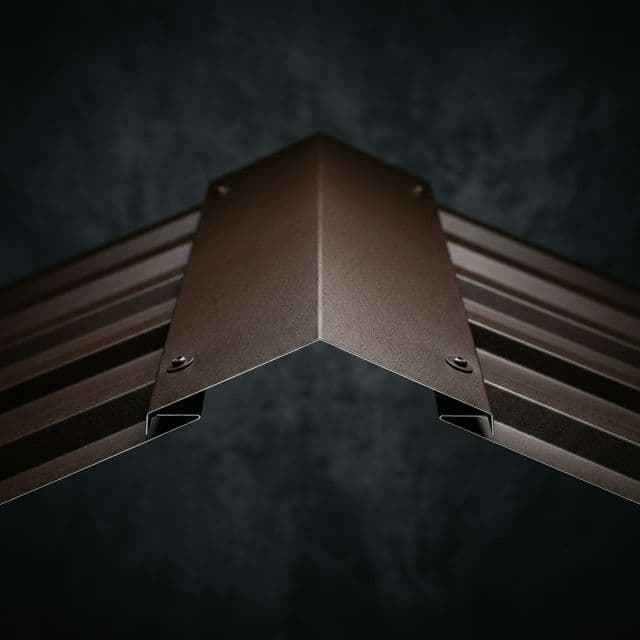
Flashing Designer: vents and ridge flashings
Without good ventilation of the ridge, roofs ‘die’. Draw the ideal air flow and get a price by developed width to the millimetre.
Frequently asked questions
That is not a leak but condensation. At night the sheet cools below the dew point temperature, so the moisture from the air condenses on its underside and drips.
English version of the Croatian original: Znoj Krovova: Fizika kondenzacije i zašto filc nije luksuz nego standard.