Sandwich panel thickness by use: U-values, the regulation and what really saves on heating
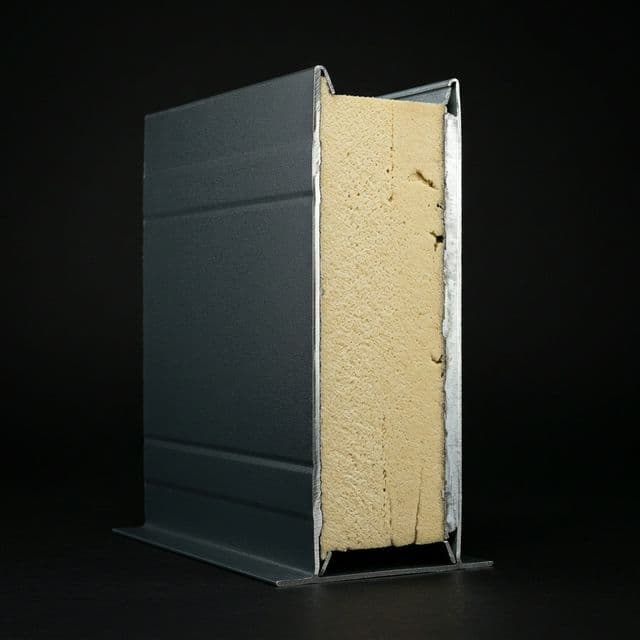
With sandwich panels the most expensive mistake is not buying too thin a panel — it is buying a thickness that does not match the use. For a canopy 100 mm of insulation is money thrown away; for a heated production hall 40 mm guarantees a cold plant, condensation on the joints and a gas bill that rises every winter. The core thickness is a pure engineering choice: the required U-value, the temperature of the space and the point of the sensible optimum. Let us go through the numbers.
Physics in 60 seconds: λ and U
The insulating power of the core is described by the thermal conductivity λ: PUR/PIR foam typically 0.020–0.023 W/mK, mineral wool 0.039–0.043. In practice that means: for the same thermal protection a wool panel has to be roughly twice as thick (and twice as heavy) as PIR — wool is chosen for the fire class A1, not for the heat, as we set out in the article on the PUR vs PIR core. The whole panel is described by the U-value (W/m²K) — how much heat passes through a square metre of panel per degree of difference. Less = better, and it is declared to EN 14509 in the declaration of performance (DoP) of every panel — that is the figure to ask for, not the slogans of the brochure.
Choose the thickness of the PIR panel
Core to scale · sheets enlarged for legibility
U-value (roof)
0.20–0.22 W/m²K
Regulation (NN 128/15…102/20)
Roof of a heated hall (≥18 °C)
Transmission loss through the roof of a 1,000 m² hall (indicative)
Safely below the roof limit U ≤ 0.25 for heated spaces in the continental region.
* The U-values are ranges of the factory declarations of roof PIR panels to EN 14509 (Paneltech, Balex, BEWI, Ruukki) — the DoP of the specific panel is authoritative. The energy loss is our own indicative calculation for the transmission through the roof alone (heating degree days ≈ 2,800 °C·day, continental Croatia), without ventilation, walls and gains — it serves to compare thicknesses, not as an energy performance certificate.
What the regulation really requires
The Croatian Technical Regulation on the rational use of energy and thermal protection (NN 128/15 … 102/20, Annex B, Table 1) sets the limits for continental Croatia: spaces heated to ≥18 °C — roof U ≤ 0.25, wall U ≤ 0.30 W/m²K; spaces at 12–18 °C — roof ≤ 0.40, wall ≤ 0.50. In panels: the roof of a heated hall = PIR 100–120 mm (80 mm only if its DoP proves ≤0.25), the wall of a heated hall = PIR 80 mm, a workshop at 15 °C passes with 60 mm on the roof. For unheated buildings the regulation sets no U-requirement — there a panel of 40 mm (or trapezoidal sheet with anti-condensation fleece, as we wrote in the article on condensation) is a perfectly rational choice. Cold stores are a league of their own: +2…+8 °C typically 80–100 mm, chambers at −18 °C and lower 100–150 mm, deep freezing over 150–200 mm as well.
The diminishing saving: where the sensible optimum lies
On the roof of a hall of 1,000 m² the step from 40 to 80 mm cuts the transmission losses through the roof roughly in half (~37 → ~18 MWh a year in our indicative calculation); the step from 80 to 120 mm brings another ~6 MWh. The saving is diminishing — the greatest gain is between too thin and correct, and not between correct and the thickest. That is why the thickness is chosen by use and by the regulation, and only then by energy ambition (at the energy prices of today, the difference from 40 to 80 mm on gas heating is measured in thousands of euros a year — the exact amount depends on your price per kWh).
The dew point: when too thin a panel “sweats” on the inside
The inner surface of the panel is always colder than the air in the space — the higher the U, the colder it is. At 18 °C inside and −15 °C outside, a roof panel of 40 mm holds the inner surface at ~16 °C, and one of 100 mm at ~17.3 °C. In a dry hall it makes no difference; but in damp spaces (cattle sheds, wash bays, food processing, RH 85–90 %) the dew point is at ~15.4–16.3 °C — too thin a panel then works on the dew point, and the first drops appear at the coldest points: the joints and the screws (point thermal bridges). The regulation expressly requires that surface condensation be prevented (calculation to HRN EN ISO 13788) — a damp use means a thicker panel, concealed fastenings and a clean seal in the joint.
Good news for the substructure: the thickness of the PIR weighs almost nothing. A roof panel of 40 mm comes in at ~10–11 kg/m², one of 120 mm at ~13–14 kg/m² — a step of only ~3 kg/m², negligible against the snow. A thicker panel is also stiffer, so it carries larger purlin spans. What really loads the structure is mineral wool (roughly twice as heavy as PIR) — take that into account when choosing the core, together with the length of the screws: panels take screws of 90–150 mm, which we keep in the shop.
The engineering prescription
- Canopy / unheated store: 30–40 mm (or trapezoidal sheet + fleece) — the regulation asks for no more.
- Workshop / agricultural building (12–18 °C): roof 60 mm, wall 50 mm.
- Heated hall (≥18 °C): wall 80 mm, roof 100–120 mm (80 only with a DoP ≤ 0.25).
- Damp plants and cold stores: thicker than the regulation + concealed fastenings; chambers at −18 °C: 100–150 mm and more.
The Modeco catalogue holds PU panels of 30 and 50 mm and a PIR panel of 80 mm (prices on request); other thicknesses and cores we supply to order — tell us the use and the temperature of the space, and we will come back with the thickness and the DoP figures that pass the regulation.
PIR Panel 80 mm
PIR core λ=0.020 W/mK, reaction to fire class B-s1,d0 to EN 13501-1. It solves the wall of a heated hall straight away; for the roof of a heated hall ask for the declaration or move up to 100–120 mm.
Frequently asked questions
For a heated hall the thickness is chosen so that the limit U-values of the Croatian regulation are met: 0.25 W/m²K for the roof and 0.30 W/m²K for the wall. In practice that means thicker panels on the roof than on the wall.
English version of the Croatian original: Debljina sendvič panela po namjeni: U-vrijednosti, propis i što stvarno štedi na grijanju.