Sandwich panels: PUR or PIR core — how to choose the right insulation for your building
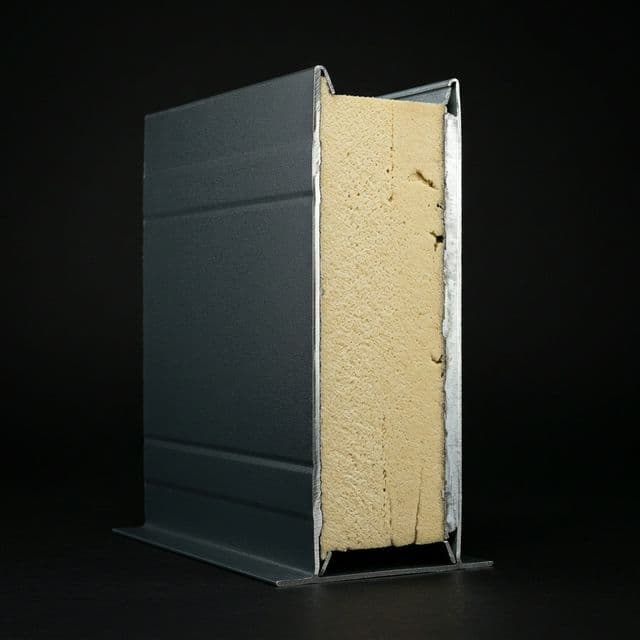
When we speak of the industrial construction of the modern age, roof and wall sandwich panels represent the unrivalled standard of thermal efficiency and speed of installation. Behind the simple metal facade, however, hides the complex chemistry of polyurethane (PUR), polyisocyanurate (PIR) and mineral wool. Choosing the wrong filling can mean the difference between a building that holds its temperature perfectly and one that presents a serious threat in the event of a fire.
A sandwich panel only 50 mm thick replaces, in insulating terms, more than half a metre of classic brick wall or concrete. That impressive thermal stability arises from the cellular structure of the PUR foam inside steel sheet 0.50 mm thick, galvanised and plastic-coated on both sides. The real engineering battle, however, is fought in the specifications for fire resistance and load capacity.
The Chemistry of Fire: PUR vs. PIR
Polyurethane foam (PUR) was the standard for decades, valued for its remarkable thermal resistance (a lambda value of about 0.022 W/mK). Its weak point, however, is its behaviour at high temperatures. When it is exposed to an open flame, PUR burns and melts. This resulted in the development of PIR (polyisocyanurate) technology — a structurally modified chemical mixture created to form a protective charred layer (a carbonised crust) on contact with the highest temperatures.
PUR Foam (Class B3/B2)
Excellent thermal insulation at a more affordable price, but with considerably lower resistance to flame. Ideal for cold stores and smaller agricultural buildings where fire regulations are not the primary requirement.
PIR Foam (Class B-s1, d0)
The superior fire-resistant modification. Slow burning without dripping of burning matter, and minimal smoke development. An absolute requirement for modern public, commercial and industrial halls.
Mineral Wool (Stone Wool): The Fire Shield
While PIR offers high resistance (most often 30 to 60 minutes of preventing fire from breaking through), sandwich panels with a core of mineral (stone) wool are the fireproof champions. Because of the very nature of volcanic rock, mineral wool is classified as entirely non-combustible (class A1). These panels are capable of holding the structural integrity of the wall during a fire for 120 and, with thicker sections, even 180 minutes (EI 180).
The technical compromise of mineral wool, however, is its weight and its thickness. Because of the higher lambda value (~0.040 W/mK), twice the thickness of wool is needed to achieve the same insulating effect as a single PIR board. The wool can also absorb moisture, so the panels demand flawless installation and sealing at the joints.
Structural View
Technical limit values
In conclusion, the design and ordering of panels has to be carried out in close correlation with the structural design of the fire compartment for each hall. PIR is the sovereign ruler of the balance between high insulating power, safety and speed of installation, while mineral wool is the choice exclusively in spaces of enormous hazard and on fire-separating partition walls.
The core is one decision, the thickness another — the thickness is determined by the use and by the prescribed U-value, and not by feeling: panel thickness by use. And even the best panel still lets moisture through the joints and the cold bridges if the vapour barrier and the ventilation are not solved: condensation in a hall.
PIR Panel 80 mm
PIR core λ=0.020 W/mK, fire class B-s1,d0 to EN 13501-1. Other thicknesses and cores are supplied to order.
Frequently asked questions
PIR foam behaves better in fire than PUR, so it is required where fire requirements are stricter. The reaction-to-fire class is declared to EN 13501-1.
English version of the Croatian original: Sendvič Paneli: PUR vs PIR ispun - Kako odabrati pravu izolaciju za vaš objekt.