EN 1090-2 and EXC classes: what the certificate of your steel hall really guarantees
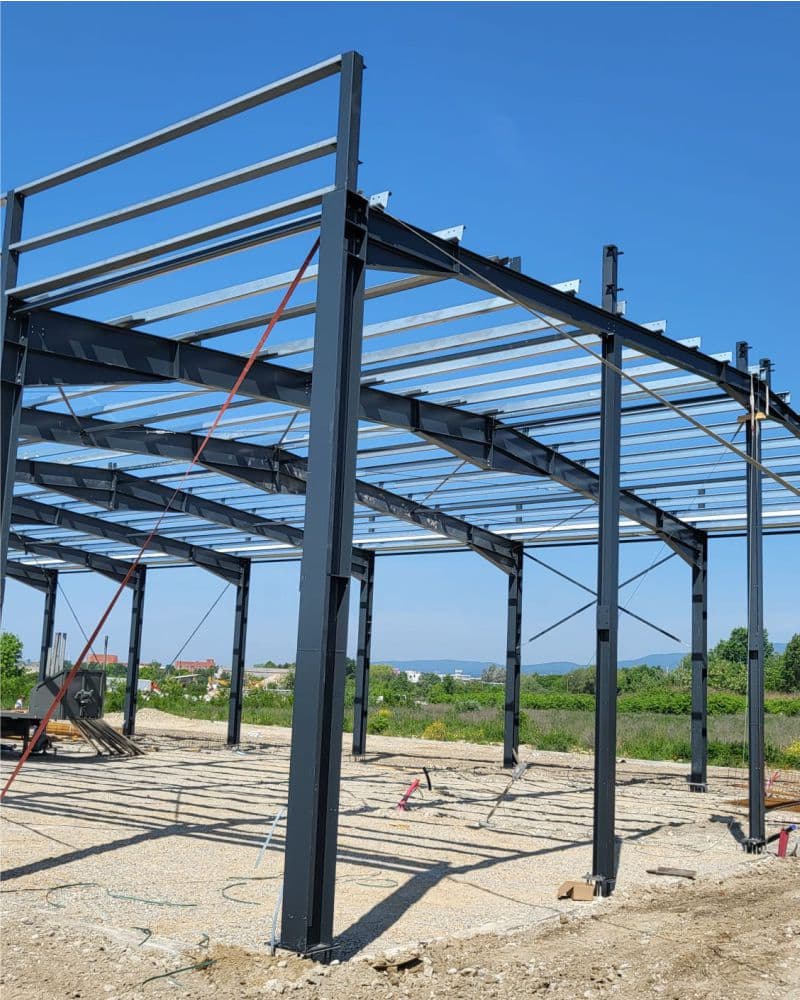
The quotation for a hall says “executed to EN 1090-2” and the client reads that as a seal of quality. In fact it is a sentence with no content until it is stated WHICH execution class — because the same standard covers both a canopy and a crane hall, and the difference between them is twice as much weld testing, a stricter quality for every weld, a welding engineer in the plant and complete traceability of every batch of steel. This is a guide through what that sentence actually conceals.
Two standards that are constantly confused
EN 1090-1 is the standard under which a load-bearing steel component is CE-marked. On the basis of it the manufacturer has a certified factory production control, issued by a notified body, and issues a Declaration of Performance. EN 1090-2 is the execution standard — it prescribes how the steel is cut, drilled, welded, bolted, erected, protected against corrosion and inspected. From that follows something that surprises most buyers: a manufacturer certified only for EXC2 may not supply an EXC3 structure, however good its welds may be. The certificate carries the class, and that class is the upper limit.
And one frequent confusion that should be cleared up: EN 1090-2 does not certify profiles. A steel profile comes with an inspection certificate to EN 10204 under its own product standard; EN 1090 relates to the structure that the manufacturer builds out of those profiles.
How the class is determined — and who determines it
The execution class arises out of three questions: how great the consequences of a possible failure are (CC1–CC3), what the loading is (static or fatigue/seismic, SC1–SC2) and how it is executed (bolted or welded, up to S275 or from S355 upwards, PC1–PC2). Try it on your own building:
Which execution class applies to your building?
Consequences of a possible failure
Type of loading
Method of execution
Execution class
EXC2
Welding requirements
EN ISO 3834-3
Weld quality
EN ISO 5817 quality level C
Additional NDT (butt welds)
10 %
Welding coordinator
level B (up to S355, t ≤ 25 mm), otherwise S
Traceability of the material
by marking
* An indicative result from the CC × SC × PC matrix (EN 1090-2, the earlier Annex B; in the 2018 edition the selection moved into EN 1993-1-1/A1:2014, Annex C). The execution class is bindingly determined by the designer, who under the Technical Regulation for Building Structures enters it into the quality control and assurance programme that is part of the main design. The NDT percentages refer to transverse butt welds to Table 24.
Two things catch the eye at once. First: a hall welded from S355 is automatically PC2, so even the simplest store ends up in EXC2 — EXC1 is in practice reserved for unwelded structures or steel up to S275, and the more recent standard does not recommend it for general use at all. Second: an overhead travelling crane pushes a hall towards EXC3, because a crane runway requires a fatigue verification and so the building moves into SC2 — with consequence classes CC2 and CC3, that is with practically every production or storage hall, that shift means EXC3. If the quotation states no class, EXC2 applies by the standard — “not written down” does not mean “the lowest one is allowed”.
One more thing that confuses people when reading quotations: the class for which the manufacturer is certified and the class that your structure requires are not the same figure. A certificate for a higher class also covers all the lower ones, so a plant certified for EXC3 legitimately supplies an EXC2 hall as well — the reverse does not hold. When our pages say that we work in EXC3, that is the upper limit of what we are allowed to supply; for a particular building the class is still prescribed by the designer in the structural calculation.
What really changes between EXC2 and EXC3
This is not paperwork but a different plant. With EXC3 every weld must satisfy a stricter criterion (quality level B instead of C to EN ISO 5817), the extent of testing is doubled (20 % of transverse butt welds instead of 10 %, 10 % instead of 5 % at T-joints), a welding quality system to EN ISO 3834-2 instead of -3 is required, and the traceability of the material must be unbroken from goods receipt to handover. The level of technical knowledge required of the welding coordinator to EN ISO 14731 rises: for a typical hall of S355 up to 25 mm thick that is level S instead of B, and for thicker elements and higher grades of steel level C — in practice a welding engineer within the company. A prefabrication primer on the faying surfaces is permitted only if it has been proved that it does not harm the quality of the weld, and if a permanent backing is used on single-sided butt welds it must be continuous and in close contact with the parent material along the whole length of the joint.
To give a sense of scale: on a hall 7 metres high the permitted inclination of a column is about ±23 mm, but a column carrying a crane runway may deviate by only ±7 mm. The same plant, the same team — an entirely different measuring protocol.
Nine documents you may ask for before signing
- Certificate of factory production control to EN 1090-1 — with the execution class and the period of validity stated.
- Certificate EN ISO 3834-2 or -3, with a list of the approved welding procedures and material groups.
- Appointment of the welding coordinator to EN ISO 14731 and proof of their level.
- A list of the WPSs with the corresponding procedure qualification records (WPQR).
- Welder certificates to EN ISO 9606-1 — check whether the confirmation has been signed within the last 6 months.
- An inspection and test plan with the NDT percentages, and the reports, stating the waiting time before testing.
- Certificates of the NDT personnel to EN ISO 9712, level 2.
- Material inspection certificates to EN 10204 — for S355 type 3.1 is required, not 2.2.
- The quality control and assurance programme from the main design — under Croatian rules the execution class must be stated there.
Pay particular attention to the eighth point. For steel above S275 the standard requires an inspection certificate of type 3.1 — a certificate with the test results of the actual batchyou have received, validated by a representative of the manufacturer independent of production. Type 2.2 is a general report and is not sufficient for S355. That is the difference between “steel of this kind is S355” and “thissteel has been proved to be S355”.
Anti-corrosion protection: “durability” is not a guarantee
Under EN ISO 12944 a structure is given a corrosivity category according to its environment — for a hall in rural Slavonia that is typically C2, in an industrial zone C3, while the inside of a livestock building with ammonia and permanent damp calls for C4 or more — the standard does not list livestock buildings among its examples, so that is an engineering judgement, but an oversight that is paid for dearly. With the category goes a durability range: low up to 7 years, medium 7–15, high 15–25, very high over 25. The key point: durability is the expected time until the first major renewal of the coating, and not a warranty period.
Alongside the coating stands hot-dip galvanising to EN ISO 1461: on profiles thicker than 6 mm the coating is at least 85 µm as a mean value, or 70 µm locally. With the corrosion rates of zinc from EN ISO 9223 that gives, in categories C2–C3, a life of the order of 40 to over 100 years — with the note that those rates are first-year values and the long-term ones are lower, so the estimate is conservative. In the milder categories galvanising is a solution in its own right; in C4 and C5 the standard treats it as a base for a coating and not as a replacement for it. What zinc protection looks like on thin sheet we wrote about in the article on the Z275 standard.
The engineer’s recipe
- Before the quotation: ask the designer which execution class has been entered in the main design — that is the only governing figure.
- When comparing quotations: check that they all carry the same class. EXC3 against EXC2 is neither the same goods nor the same price.
- If you are planning a crane: say so straight away — adding a crane runway afterwards changes the class, the calculation and the tolerances.
- Before handover: ask for the nine documents from the list. Proper documentation is part of the delivery, not a favour.
More on load-bearing profiles, steels and the execution of our structures on the steel structures page, and on finished buildings on the prefabricated halls page.
What the inspection that follows from the class looks like — the methods, the extended testing and a report that proves something — we have set out in the article on weld inspection and NDT. The class also governs the tolerances, and those are the easiest to overlook because they do not bring a hall down — they simply add up until the door stops fitting into the opening: erection tolerances and why parts do not fit.
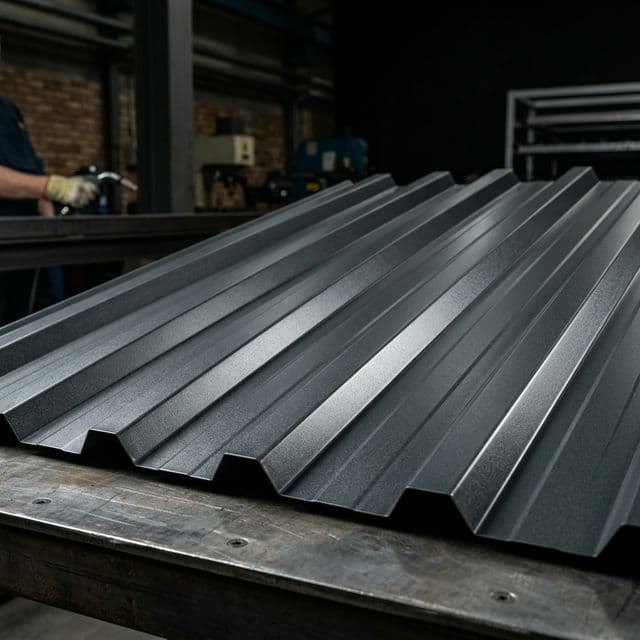
Trapezoidal Sheet T-45 RAL 7016/9005
The EN 1090 standard covers the load-bearing skeleton — the roof covering is a separate system. T-45 is the profile with the greatest load capacity in our price list, for the large purlin spacings of an industrial hall.
Frequently asked questions
EXC is the execution class to EN 1090-2 and it determines how strict the control of fabrication has to be — from the weld quality criteria and the extent of testing to the traceability of the material. The sentence “executed to EN 1090-2” says nothing unless the class is stated.
English version of the Croatian original: EN 1090-2 i EXC klase: što certifikat vaše čelične hale stvarno jamči.