Skip to content
ShopValley flashingsValley Flashing with Drip Edge
Price by developed widthUV-GLValley Flashing with Drip Edge
Standard

UV-GL

Valley Flashing with Drip Edge

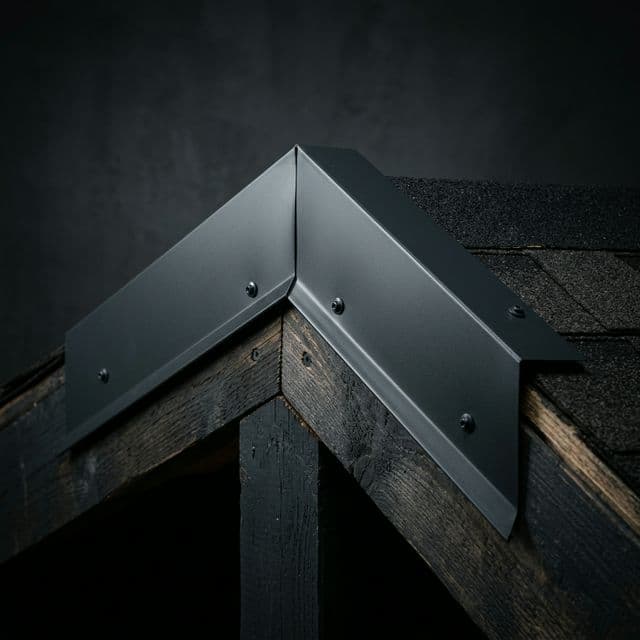
Valley flashing (valley) with a drip edge for the junction of two roof planes.

Category

Valley flashings

Unit

per linear metre

Quality guarantee

Steel S320GD, Z275 galvanising to EN 10346
Certificates available on request
Delivery: 3–7 working days
Direct from the factory in Đakovo

Similar products

All in the category

Category guide

Valley flashings — application, standard and installation

Where it is used

The valley flashing is the sheet-metal channel at the junction of two roof planes meeting at an angle, where two flows of water come together. Modeco makes valley flashings with a drip edge, recessed, recessed with a drip edge, the valley flashing for planes of the same pitch, and valley flashings for clay tiles — with a drip edge and recessed. The width of the valley is chosen according to the catchment area of both planes and the pitch.

The standard and what it guarantees

The sheet is steel S320GD, galvanising Z275 (275 g of zinc per m², both sides) to EN 10346, polyester coating 35 µm. It is folded on a CNC machine to a tolerance of 0.2 mm, so the profile repeats identically on every piece. The sheet standard guarantees the steel substrate and the zinc thickness, not the shape — the shape and the developed width are set by the customer.

What to watch out for during installation

The valley flashing is laid on a solid substrate (boarding or panels) from the eaves towards the ridge, with the pieces overlapping in the direction of flow; the roof covering is cut so that a clear channel is left in the middle. The middle of the valley is not drilled — fixing is at the sides with clips or cleats that allow for expansion. The drip edge along the edge prevents water from spilling under the covering in heavy downpours and with lying snow.

Questions and answers

Frequently asked questions: Valley flashings

What does a valley flashing with a drip edge mean?

The drip edge is a water fold — a raised fold along the edge of the valley flashing that holds the water back so that it does not spill under the roof covering when the channel is working at full load. The recessed valley without a drip edge lies lower, in the plane of the covering; both are made of galvanised steel S320GD Z275 to EN 10346 with a coating of 35 µm.

How is a valley flashing fixed without drilling?

With clips or cleats at the sides that hold the edge of the sheet but allow it to lengthen in the heat; the middle of the channel is left undrilled because the most water runs there. The pieces are folded to a tolerance of 0.2 mm so that the overlaps fit together without a gap.

Which valley flashing is used under clay tiles and which under sheet?

For clay tiles the valley flashings for roof tiles (with a drip edge or recessed) are used, because the tiles sit on battens above the level of the valley; for sheet-metal coverings the recessed valley flashing or the valley flashing with a drip edge in the plane of the covering. The valley flashing for the same pitch is used where planes of equal pitch meet. All are made of sheet S320GD Z275 to EN 10346.