Prefabricated hall price 2026: the real cost breakdown by item
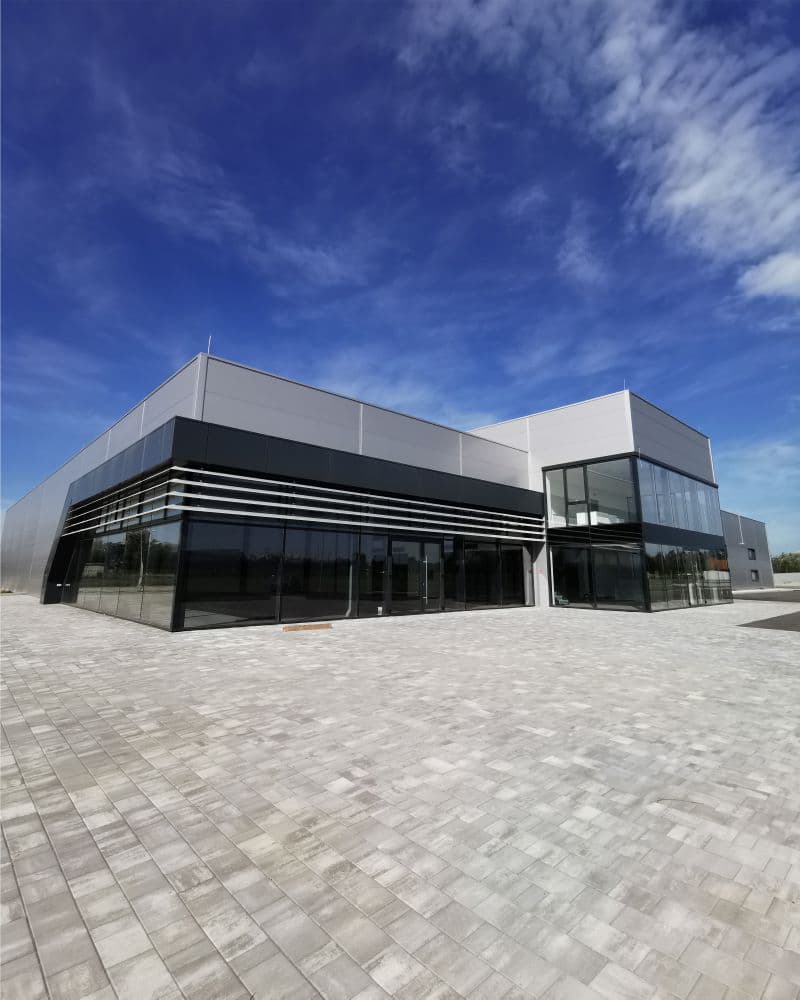
When someone types “prefabricated hall price” into a search engine, two kinds of answer come back: round figures with nothing behind them and “price on request”. Neither helps. This article takes a third route — we are publishing the real calculation of our standard structure, item by item, with the mass, the price per kilogram and a clear line around what that price is and what it is not. Along with it: which costs the law abolished or moved between 2024 and 2026, and how quotations per kilogram are compared without the kilogram misleading you.
A calculation you can check: 10 × 30 × 5 m
This is the structure of our quotation template for the standard hall 10 × 30 m, 5 m high, calculated for continental Croatia (Đakovo, August 2026). The amounts are starting “from” prices — the final price depends on the location (snow, wind, ground), on the current price of steel and on the scope of the delivery, so only a written quotation is binding. But the structure is real: every customer gets the same document, with a 3D model of the structure and a legend of the sections from the structural software.
| Item | Quantity × price | Amount net |
|---|---|---|
| Primary structure — 12 columns IPE 330, rafters IPE 240 with a haunch, CHS struts, wind bracing; steel S235, corrosion protection by painting, +3 % of the mass for welds | 7,438 kg × from 2.20 €/kg | from 16,360 € |
| Roof purlins — Z-profile, galvanised sheet 2 mm, centre spacing 1 m | ≈ 356 m | from 4,860 € |
| Transitional secondary beams SIGMA 200 | ≈ 60 m | from 1,080 € |
| Fasteners for the bracing | complete set | from 240 € |
| Steel structure in total | from 22,500 € |
A few engineering details from that table, because they are exactly what separates a quotation from an advertisement. The combination of a stronger column (IPE 330) and a slimmer rafter (IPE 240) with a haunch is the classic solution for a portal frame with a pinned base: the haunch takes the peak moment at the joint, so the rafter may be smaller. The mass includes the standard allowance of 3 % for welds. There are ~356 metres of purlin because a roof plane 30 m long with the rows spaced 1 m apart gives roughly 12 rows — that figure can be recalculated, and that is the point of a public calculation.
From the structure to “turnkey”: where the rest of the money is
Now what most quotations pass over in silence: the structure is typically a fifth to a third of the total investment in a finished hall — on real projects that share runs from roughly 16 to 29 %. That is not a quotation but the arithmetic of shares — and that is why two quotations may be compared only once it is known for both what is inside.
| Cost basket | Behaves | Charged by |
|---|---|---|
Steel structure The only item in this table with a public price — see the calculation above. | ≈ a fifth to a third of the investment | the manufacturer of the structure |
Roof and wall envelope Trapezoidal sheet with fleece for unheated buildings; panels 60–100 mm when it is heated. The panel thickness is a decision about the heating bill, not about the catalogue. | grows with the insulation | the manufacturer of sheets and panels |
Foundations and floor slab The geotechnical report decides. Poor ground can eat up in the foundations the difference between two quotations for the structure. | depends on the ground, not on the hall | the building contractor |
Erection with a crane Fabrication of the structure runs in parallel with the foundations — that is why prefabricated construction is faster, and not because it is “just bolted together”. | depends on the location and the access | the erection team |
Services and fire protection Fire-protection requirements can push the price higher than the structure itself — especially with workshops and production plants. | the greatest unknown | the trades |
Design, permits, connections Public charges have their own calculator in a separate article — the utility contribution per m³ and the power connection per kW. | the more fixed part | the designer and the public authorities |
For the public charges — the utility contribution per cubic metre and the power connection per kilowatt — we have a separate article with a calculator, and the nine phases from an enquiry to the occupancy permit are worked out in the big guide for 2026
What is different in the 2026 bill of quantities from what is said
Part of the “folk knowledge” about the costs of a hall went out of date overnight — the regulations have changed more in two years than in the previous ten. Four facts with their source, so that you do not have to take them on trust:
Water contribution
0 € — abolished on 1 April 2024
NN 36/24
Utility contribution (warehouse and production buildings)
falls due only once the occupancy permit becomes final
Art. 84 para. 2 ZKG
Energy performance certificate (unheated halls)
not required for industrial, workshop and non-residential agricultural buildings with low energy needs
Art. 13 ZEUZ NN 155/25
Construction started before the permit
a special charge of 1 % of the value of the works + a report to the inspectorate
Art. 72 ZoG NN 155/25
The first two are a direct saving and a shift in the cash flow. The third means that an unheated hall does not carry the cost of certification. The fourth is a warning: anyone who “starts with the foundations while the papers wait” pays 1 % of the value of the works and gets an inspection — and a contractor who builds without a final permit faces a fine of up to 30,000 €. In 2026 patience is literally cheaper.
Price per kilogram: a useful measure that can mislead
Structures are quoted by the kilogram — with us from 2.20 €/kg, which includes the material, the fabrication, the corrosion protection and the allowance for welds. Quotations are legitimately compared by the kilogram, but with two warnings that the brochures do not mention.
First: the lightest structure is not the cheapest. The connections make up less than 5 % of the mass of the frame, but over 30 % of the cost of fabrication (SCI P358) — a structure “optimised” for minimum mass can have more expensive connections than it saved on steel. Second: the grade of the steel changes the mass on the same geometry — moving from S235 to S355 on the same span takes about two section sizes off the rafter and around 17 % off the mass of the frame (bauforumstahl, standard hall calculations). Two quotations with different steel and different masses can describe the same hall.
That is why the only honest comparison is: the same geometry, the same execution class, a list of what is in the price — and only then kilograms and euros.
Modeco · Đakovo · own production
Tell us the dimensions and the use — we come back with a calculation using these same items.
No “price on request”: the structure with its mass and price per kilogram, clearly separated from what goes to other contractors. For agricultural buildings up to 600 m² a faster route to the permit applies as well.
* The calculation is a quotation template for the standard structure and for the continental climate area; the final price follows from the structural calculation for the specific location (snow, wind, ground) and from the price list valid at the moment of the quotation. The share of the structure in the total investment (≈ 16–29 %) is an empirical range from real projects, not a promise.
Frequently asked questions
The steel structure of the standard hall 10 × 30 × 5 m starts at approximately 22,500 € excluding VAT: a primary structure of 7,438 kg at a price of 2.20 €/kg and upwards (IPE 330 columns, IPE 240 rafters with a haunch, bracing), roof Z-purlins and SIGMA sections. The final amount depends on the location, the price of steel and the scope — only a written quotation is binding. Foundations, the building envelope, erection and design are charged separately.
English version of the Croatian original: Montažna hala cijena 2026: stvarni troškovnik po stavkama.